
How It's Made
01
The walk
Roughly once a week, along Lake Erie. The walks are timed to storms and to the water-level swings that follow them, because that is when the lake puts the good material up on the beach. A calm fortnight gives almost nothing. The morning after a hard northwesterly blow gives more than I can carry.
02
Choosing on the sand
Sound and heavy for its size, dry or dryable, with a silhouette worth keeping. Punky wood goes back — if a thumbnail sinks in, the tip will plough a trench instead of drawing a line. Milled and treated lumber goes back too; heated treated wood gives off fumes nobody should breathe. Anything hosting something alive stays where it is.
03
Rinse, cut, cure
Grit rinsed off in fresh water and scrubbed out with a stiff brush, because embedded sand kills nibs. Then cut, and then the slow part: weeks of drying indoors with air on every side. Rushing the cure is how a good piece of driftwood becomes a cracked piece of driftwood after it is already burned. Freshwater drift needs no desalting, which is one advantage the lake has over the ocean.
04
Reading the piece
Before the tool comes out, the piece gets turned in the light. Growth rings, rays, checks, and the hard black spalt lines that fungus drew while the wood lay wet. A knot is already the tonal weight of an eye. A forked spalt line is already a river. The design gets chosen after the wood is in hand, never before.
05
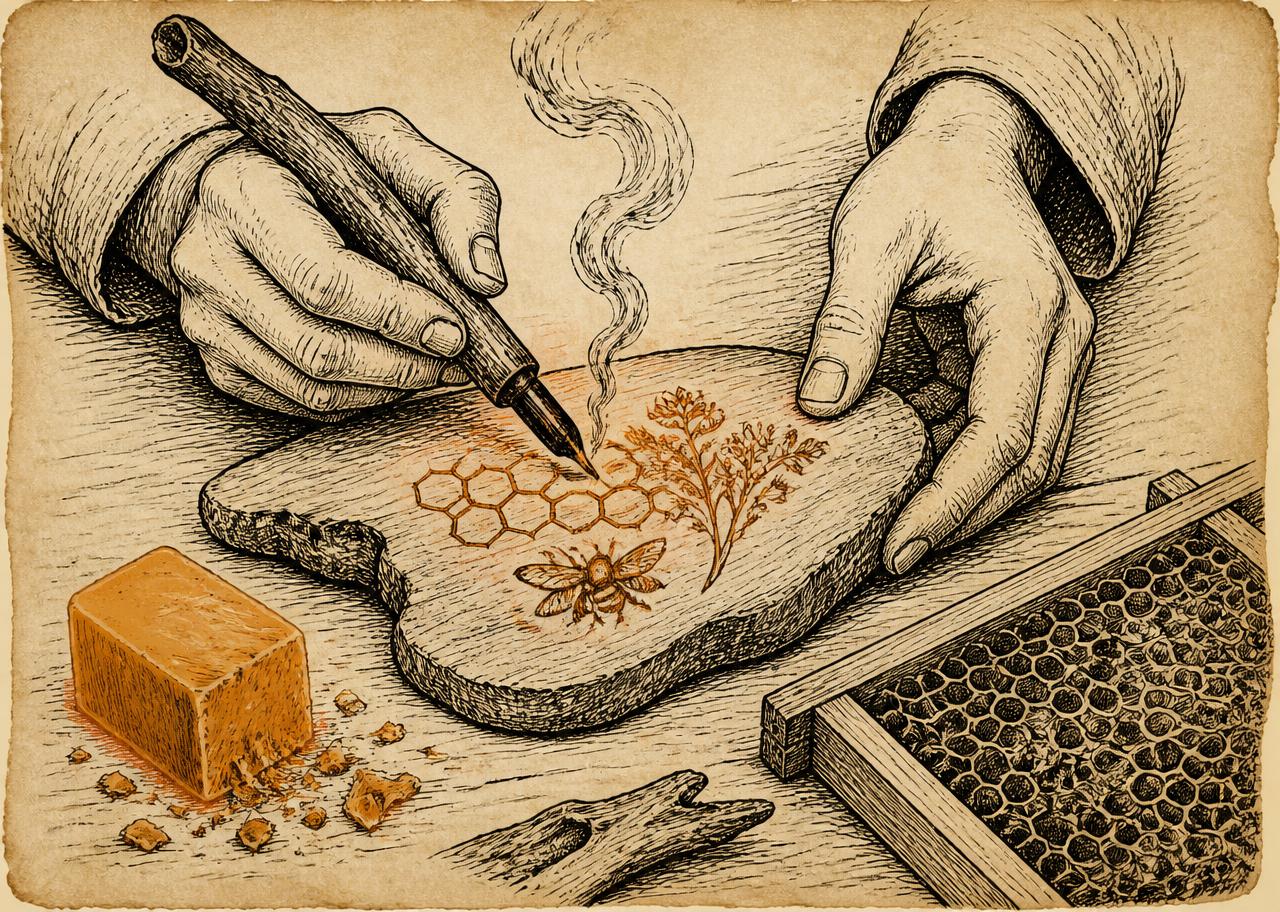
Burning
A heated nib, one stroke at a time. Light contact gives caramel, a slower pass gives chocolate, and a held pause gives black. There is no undo: you build around a mistake or you sand the surface off and start again. The line sits slightly recessed with a faint raised lip, so you can feel the drawing with a fingertip. Nothing is stained or inked — that colour is heat.
06
Beeswax, from our own hives
Wax from the family farm's hives, warmed and worked into the open grain, then buffed until it stops feeling tacky. It slows moisture moving in and out of the wood and deepens the contrast of the burn. No varnish, no lacquer: a film finish yellows and eventually flakes off along the burned lines, taking surface with it. Wax is repairable, which is the whole reason for using it.
07
Hemp, and the sage
Hemp lace comes from a local provider, buckled so it adjusts and so a pendant can be swapped off it later. The sage is separate work: grown by hand in clay pots and propagated from cuttings using techniques Monkey Mike developed. Garden-grown herb bundles, never wild-harvested, tied in threes and sold with a burning block cut from the same driftwood.
“Nature made the design. I'm just complimenting it.”
More on driftwood as material